Monday, September 24, 2007

At The Richmond Art Center


I took my partner and parents to an exhibit at the Richmond Art Center, where one of my paintings was featured in the members' only show. I had made this portrait of my mother about two years ago during the winter. She had posed for about eight or nine two hour sessions. The members' show is staged in one of the center's hallways, so we saw the other exhibits first before we got to my mom's portrait. There was the Neighborhood Public Art show in collaboration with the city of Richmond, a photography retrospective celebrating the California College of Arts Centennial, a member's showcase room featuring five artists chosen from last year's members only show, and finally the member's only show. The event was very well attended and diverse, in fact, we could barely squeeze in through the crowd!

Wednesday, September 19, 2007

With No Preconceived Notions


I have been working with the expression of energy through line and brushstroke on canvas, board, and paper. This is the opposite of what I do with my other work, where content, color, and form take precedence over movement. When you are working towards creating the illusion of distance, texture or an environment, it is an extra challenge to convey the stored energy of the brushstroke. I picture the work of expressionists Robert Motherwell and Emily Carr when I think of the preservation of this energy, whether the work is abstract or representational. In these pieces, I abandon the narrative of representation and embark on the joy of movement for its own sake.

Saturday, September 15, 2007

Painting Flowers

Here is a painting done in two afternoons. My neighbor brought these hydrangeas she had picked that same day. In Spanish, they are called hortensias. They were sitting in front of one of my studio windows. I was fascinated that they had not wilted or fallen apart the day after, so I painted them. Here I must explain that two years before I had had a conversation with a florist who told me she would "never do a wedding where hydrangeas where involved," because of their fragility. I wanted to drive over to her flower shop and tell her these hydrangeas had lasted a whole week.

I confess I am not a fan of painting flower arrangements. There is something about the subject that will make viewers smirk inside. Some people have told me I can paint flowers "so well" because I'm female. Ugh!

Should I then move on to disturbing, undecypherable subjects? "Only if you want to sell to collectors," advised a colleague, the assumption being that regular folks (those who don't care whether their art is "serious" or not) like the soothing, the familiar, the kitschy, or beauty for beauty's sake and nothing else mixed in with their art.

Tuesday, September 11, 2007

On Matters of Size

How do artists decide on the size of a piece? This is, assuming this decision is up to the artist, of course. Sometimes, it is not. I recall a call for entries from the California Watercolor Association. Only pieces about the size of a coffee table were considered. This effectively ruled out most field work, as it is extremely difficult to work on paper of that size outside of a studio. This in turn meant that most of what I had done could not be sent.

So if artists can choose size, how do they go about this? I can only talk about my own experience. Some of these choices are arbitrary and have to do with what's available at the moment, and how badly you want to hop in your car and drive to the art store. Some days, I'll just grab an odd-sized canvas or piece of paper because it's been lying around too long, then I'll challenge myself to find a composition that fits it.

More deliberate decisions usually have to do with time. A small representational piece almost always takes less time to complete than something double its size. This cabbage painting, for example, is 12 x 12 inches. It took me three two-hour sessions to paint it in acrylic, while a larger canvas would have taken me six or seven sessions. Had I decided to do it in oil, we would have had to add additional time, as some effects may have required the preliminary layers to dry a bit before I could continue.

Although some of us might like to think that the subject can dictate the final proportions, this belief has been challenged by scholars such as Anthea Callen. A chapter in her book on the impressionists explores the origins of old European standard sizes for marines, landscapes and portraits dating back to seventeeth century France. Callen found that loom size, the convenience of the merchants selling pre-assembled stretchers, and the artists' own priorities influenced size decisions more than the type of subject to be painted.

Sometimes I think of a piece's "presence" as I am considering the size I will assign to it. The same cabbage painting, in a larger size, would have been overwhelming. There is too much contrast and not enough subtlety for a larger size. Or what I paint may become too complicated for anything beyond a foot wide or long. There are days when I want to saturate the colors, and a small piece tolerates this effect a lot better than larger canvases, which would project a certain vulgarity.

Finally, there is practicality. I think of ease of transport and the expense of presentation. Almost all work done in the field is of reasonable dimensions (less than 24" long), given the challenges of that environment. Some colleagues paint in sizes they can store easily, while others choose works commanding awe in the gallery circuit, but expensive to move around. Large pieces are also more expensive to frame and in some ways more fragile.

No matter what the considerations are, size decisions are seldom made randomly, they follow artist's idiosyncrasies and practical matters much more more than any "rules."

Tuesday, September 04, 2007

For Art's Sake

It was during my middle school years when I realized the art world was not the homogeneous, equal opportunity institution I took it to be. Back in the early seventies, I bought my art supplies at a mom and pop framing and art store in Hato Rey, Puerto Rico. The display shelves in the beyond-cluttered one-room storefront were taller than me. More art materials than I had ever imagined advertised their mysterious uses in a secret language I could not yet understand. I needed time to figure it all out. I wanted to examine all of the point-of-sale displays, I wanted to read all the labels, and I wanted to ask how artists used each and every object in front of me.

Upon arrival, I was always greeted by a stentoreous "Are you looking for something?" After my first time, by the tone of their voices I quickly learned I was not supposed to "loiter," that I had to bring a list of supplies for the ancient man and woman behind the counter to fill. That was the purpose of an art store, I concluded. Being that my needs and budget at the time were modest, I used to spread them out over the school semester so I could earn more opportunities to visit. I would go there just to buy one tube of Grumbacher Academy watercolor, or an eraser.

It was during one of those flash visits that the door opened and in walked a teenager not much older than me. Instead of waiting for the standard question, he greeted the ancient woman by name and spent a few minutes on chit chat. She asked him how school was going and I learned he attended an art school in San Juan for those who already had selected it as a career. Before I could process this, he left the counter and selected a few supplies for what seemed like an eternity, nothing expensive. He was never interrupted. Then he went back to the counter and asked for Damar glaze, paid for it all and left.

As soon as he was gone, I was asked again what I needed. I did not have loitering privileges because I was not going to the best art school in the island. Attending a school of the arts didn't count because its graduates didn't go on to earn BFAs. In fact, ancient mom and pop had never asked me where I went to school, the assumption being that art would not become a career for a girl in middle school. All of this didn't sink in until I reflected in the discomfort of those years a bit later and decided that, just like the rest of society, the art world is stratified. Whether we like it or not, public perception will place us in one category or another. The art store was one of my first lessons.

Tuesday, August 28, 2007

Landscapes: Acrylic vs Oil

I took my acrylics to the field. I went to a highway about three exits down the freeway, took a less traveled road up the hills, parked the truck by a small tree by the road and looked down. There was no path and no way to walk beyond the road's edge unless I wanted to roll. So I went to three other roadside sites before I settled under a large, moribund bush, hidden from the high speed cars. It was noon and everything cast a sharp shadow. Hungry cows mooed near the creek I was certain existed down the canyon. Cyclists held their loud dialogues, oblivious to my presence. Another bush obstructed my view, but by now I had realized this was the best view I could hope for.

Acrylic paint dries ultra fast, if all you've been using is oil for the past five years. Yet I was determined not to spend hours "...trying to breathe 'life', to breathe 'resonance' into an otherwise rather impersonal 'plastic'," in the words of Mark Jacobson. I had made my peace with acrylic in college, during assignments that forced me to start and finish a painting in a day. My issue was simply finishing in a period of two hours, and wresting with the lavender hill in the middle, which refused at all costs to yield the secret of its personality. I would have had this same struggle (or perhaps a worse one) had I been using oils, I reasoned. In the end I finished a satisfactory version of what I saw in my studio.

Earlier that week, I had been to the very familiar park behind my house, walked a few minutes past the gate, and found myself at the top of a small hill overlooking a path leading (where else?) into another creek. It was noon or shortly after noon, and I was wearing my polarized lenses, hemp hat, and paint-stained shirt, looking exactly like those excentric middle-aged ladies I avoided in art school. It was windy and dry. Wasps had decided to check out my palette and I was so busy trying to tie a rock to my aluminum easel that I did not see the dog walker who slowly, subrepticiously, crept up to take a peek. She said hi. I said nothing, pretending I hadn't heard. Wasn't my look eccentric enough? I waved and she got the message. After taking one last good look, she walked away and I went back to the business of landscape worship. In this painting the only struggle was the combination of wind and dryness conspiring to prevent adequate color mixing. I was trying to keep in mind the words of Brad Faegre: "Time is not the enemy with acrylics. Think of the fast-drying characteristics of the medium as an invitation to paint and repaint, until you see something you like."

Friday, August 24, 2007

Black

"I've been 40 years discovering that the queen of all colors was black." Auguste Renoir

"Black is not a color." Edouard Manet

"Without black, no color has any depth. But if you mix black with everything, suddenly there's shadow - no, not just shadow, but fullness. You've got to be willing to mix black into your palette if you want to create something that's real."
Amy Grant


Do you use black? From time to time, I hear new and experienced painters alike discuss the use (or rejection) of the oldest pigment known to mankind. Its ability to absorb light and affect other pigments determines whether an artist will avoid it completely, limit it to the darkest areas, or add it anytime dark hues are required. Just for fun, I've summarized my recall of various painterly responses to the question:

"I use prussian blue instead," an abstract painter confided rather distractedly, as she worked on a huge piece. A pigment like like ivory black will "muddy" all colors it is mixed with, she explained, and after a minute, added: "Substituting it with another very dark (but true) pigment like prussian blue will darken the mix without giving it a sooty appearance." I asked why did she want to avoid muddy colors in her line of work, but she just shrugged. Her paintings do not look sooty at all.

A portrait painter was much more specific: "Oh, I use it, but only where I want to depict absolute and total darkness. I do not mix it with other colors, I use it pure. You see, for years I "made" black by mixing other pigments, for example cadmium yellow with alizarin crimson and ultramarine blue, then I realized I could achieve a more intense effect by using mars black straight out of the tube and I've never gone back since." True to his word, his portraits did not have muddy colors either.

So far I've been using terms like sooty and muddy, without thinking of our non-artist readers. What do artists mean when they use such words? Without going into a scholarly foray into color theory (if you want it, here is Bruce McEvoy's) they mean that the addition of black will cause a pigment to lose some of its chromaticity, or its ability to stimulate the eye with its original wavelength. Think of the colors in a painting covered in grime from freeway exhaust.

I have a dear friend who paints murals on fabric. He says the public does not really care, for as long as the values contribute to the illusion of volume. He mixes black freely with other colors and this robs them of their brilliance, but at the same time, black brings so much drama to his rendering of tri-dimensional, everyday objects that it is hard to picture his work in say, prussian blue.

My own relationship with black as a pigment has developed by stages. I was forbidden to use it at the Art Students' League and while studying fine arts in college. Towards the end of my B. A. one of my professors said I was "finally ready," but I did not find myself squeezing the tube until a decade later, and only in the limited way of my portrait painter colleague. I still avoid mixing it with other colors, preferring instead to intensify contrasts once my oil or acrylic paintings are almost finished.

I use prussian blue with watercolors. I paint outdoors a lot, and there's someting about the way a carbon-based pigment looks on paper (tremendously sooty) that discourages its use, even in pure form as an accent for the darkest darks. When prussian blue proves too heavy-handed for shade, I resort to cobalt or ultramarine blue layers, seldom mixed with other colors. If I ever use lamp black, it is with a lot of restraint, as a way to highlight the absolute darkness one may ocassionally encounter in nature.

Saturday, August 18, 2007

Model Power

That it was an honour to be Sickert's model I had no doubt.Nevertheless, I had sufficient experience of this form of service to look forward to the next few hours without enthusiasm. I was standing; I had no book, my legs would ache abdominably after a time; it would be a long business and thoroughly uncomfortable. Vanessa Bell

Painting human subjects is a polarized experience for me; I paint non-models, people who are not professional models, as well as very experienced (professional) models. The non-models come to drawing sessions at the Richmond Art Center. I hire non-models, usually laborers seeking work near a hardware store not far from my house. I forget a third category: family members, and I think of them as a separate category because most have posed for me several times and are therefore more experienced ("When is my break?,"demanded my then nine-year-old niece).

The non-models are usually Latino men and women. Most have no idea of what modeling entails, but are happy to sit and get paid for it, as the work they normally do is very hard work. Just like professional models, they are very accomodating, too much perhaps, to the point where I must help them find positions that are easier to hold for the contracted time. Most have never sat for such a long time without an activity to pursue, and they tend to underestimate what it will take to keep their mind entertained for such long periods of time (we do have breaks every half an hour). I chat to keep their mind engaged and alert, or they fall asleep otherwise. They are tired from the previous workday, and in the case of women, a full workday plus childcare. I do not hold multiple sessions. I paint for as long as we can both can handle it (about four hours), then they sign the release, get paid, and leave.

The professional models in our drawing class do not need directions. Naked, they choose their own poses. Most are quite athlectic and have a repertoire organized by duration in their mind: "Well, I can stay like this for 30 minutes." Completely silent, their minds stay alert by unknown artifices, yet their personalities shine through. A few may look at you but change their gaze when you return the look. Some seem to be going through a personal inventory, their eyes dancing. Others are in a private world, not focused on anything in the room. Several are art students or artists, and others have modeled for so long that their interest in what is being drawn or painted is minimal at best. When they do discuss your art, they do so with both the jargon and ease of someone very familiar with the process: "That's very good work for a 15 minute foreshortened pose."

Non-models may not be familiar with the artist construct, but they are extremely curious about what goes on behind the pad or canvas, taking a look every time they have a break, and feeling free, for the most part, to comment on its progress in a non-evaluative manner: "Ah, I see you got to my hair but it's not finished, right?" They are comfortable asking questions about my life, artistic or more personal. "So why did you get divorced?" or "Why are you an artist?" are favorites. Over the course of our session, they will also share parts of their own life (usually before inmigrating) with me. Men and women alike feel free to share pictures of loved ones, or discuss their current troubles at work. I in turn feel free to answer most of their questions.

At the drawing class during breaks, we may speak with the model. Conversation, both with models and classmates, is mostly limited to three subjects: professional plans, travel, and programmatic changes at our art center. A personal revelation might consist of mentioning the existence of a husband or wife, or becoming specific about what we do for a living. In keeping with the fact that most of us are over forty, only over a long period of knowing one another are more specific subjects explored, e.g. "How long have you been painting?"

At the drawing class, the limits are set by the environment and traditional expectations. I can relax and focus purely on painting. In my studio, I must direct the experience much more than if I worked with a professional model. In some ways this is more tiring and expensive, yet I find the exchange I have with non-models an important part of the process. I have found the conversations essential to my understanding of the undocumented workers; without them my paintings would have a different quality, they certainly would feel more anonymous. As an example, I have my drawing class paintings. Yet these same paintings done in art class help me develop the technical freedom and ease that I try to invoke in my other work.

Thursday, August 16, 2007

Automatic Painting

You make a promise to yourself, to paint as much and as frequently as possible. Early on you may have very specific notions of what the production should look like, but these are gradually abandoned through the recognition that you will never have total control over the output. That is, if you are trying to work from the inside to the outside, if you recognize that every image and experience in your daily life, as well as your memories and feelings, have a role in your art. It feels a little overwhelming, but then you decide to ignore this insight and continue painting or drawing, no matter what. Or you may welcome it with open arms and leave the analysis to others, which is what a lot of people do. But if you are to keep your promise, you'll eventually stumble onto automatic painting.

I was in the studio one night and felt drawn to just placing paint on the canvas. I had a large amount of paint left over from another project and so I started applying it on a 12 x 12 square. I didn't want the painting "to be" anything. I had been making automatic drawings for a few days, just for fun, to take a break from representation and its stories. It is a great way to encourage creation. When I finished, I realized I had been painting one of my grandfather's homes. He had been on my mind for several days. I had been watching a slide show of the area where he lived during the fifties, and had been wondering how he and his family survived this difficult period.

Could this be called an automatic painting in the strict sense of the word? I have always engaged in automatic drawing in school, in college, during phone calls, during lectures. Some folks call this "doodling." The difference between doodling and automatic drawing is very small, in my opinion. Doodling is more automatic, than say, standing in front of a canvas seeking some kind of trance. I decided to go with the strict interpretation of this method and pronounce my small painting as not automatic after all. At some point my consciousness took over to "direct" the image arising out of my subconscious:


Hermetists Augustin O. Spare and Frederick Carter would disagree with this strict interpretation: "The Hand must be trained to work freely and without control, by practise in making simple forms with a continuous involved line without afterthought, i.e. its intention should just escape consciousness. Drawings should be made by allowing the hand to run freely with the least possible deliberation. In time shapes will be found to evolve, suggesting conceptions, forms and ultimately having personal or individual style. The mind in a state of oblivion, without desire towards reflection or pursuit of materialistic intellectual suggestions, is in a condition to produce successful drawings of one's personal ideas, symbolic in meaning and wisdom." Here's the link to the complete article.

It only happens if I am in a receptive and open mode, it never takes place when my mind is cluttered with projects, worried, or directed at a single goal. Letting my mind wander always takes me to some relatively unexplored place. I forget about "wasting" art materials. But it certainly feels as if I am standing on less solid ground. There are no goals, and therefore no sense of completion. There is no emerging recognizable image, only the feel of your chosen media. It feels exactly like a breakup with some long-held sacred idea, and this is always healthy.

Wednesday, August 15, 2007

Painting Solo

Lately, maybe because the good weather beckons, or because everyone else seems to be doing their summer traveling, I've been painting outdoors by myself quite a bit. I might bring watercolors, oils, or more recently, acrylics. My setup is not too complicated. By now I have a system that enables me to get ready in about 15 minutes.

I carry a smallish canvas. If I am doing oils and the canvas is longer than 15 inches on any of its sides, I might attach canvas straps to the stretcher frame to facilitate transport without smearing. This is specially helpful under windy conditions, when oil paintings can be flipped off your hand in a nanosecond. You can attach the straps in "backpack" style. The canvas goes on a plastic and aluminum field easel that weights less than 3 pounds.

There used to be a time when I could sit on the floor for hours at a time. These days, I am happy to cart a variety of lightweight seating gigs, depending on how far away will I walk from my truck. I also enjoy the perspective they provide, otherwise all of my compositions would be done at floor level! I find folding aluminum/canvas seats comfortable and lightweight. They are also cheap. I have one which doubles as a backpack, it's got pockets with zippers for supplies. The straps on this seat bag are flimsy, but I've walked with it without major problems. However, this is not the setup you want if you're cycling to your location. Because of those same flimsy straps, the seat bag tends to sway, destabilizing your moves.

If you're walking more than a couple of miles, or if you're taking your bike, you want a regular backpack with a flap on top to secure your easel and seat tightly against your back. I have an old one that can get smeared with paint. It needs to feel comfortable if you're carrying several bottles of water (as when you use acrylics), and be waterproof if you are carrying watercolor paper. The ones at the art store tend to be too expensive.

When I first began painting solo, my family was concerned because I am female and not built like a wrestling champion. To avoid unwanted human attention, I try to find slightly-out-of-the-way spots where I don't have to worry about who is coming up behind me. I either sit with my back against a tree or fence, or I sit at a spot where I can see who's coming before they see me. Hilltops are great for this. I also began bringing a can of mace and a stick, for the ocassional off leash pit bull I might encounter in the regional park near my home. No problems so far, since considerate owners do not allow their dogs to stick their nose on my palette. There are mountain lions and other critters in these parts, but if I thought about this and other dangers, I would never paint.

My partner insists I take my fully-charged phone, some emergency money, and a first aid kit. I used to laugh it all off, but I've used the kit twice since I began carrying it. Once to help a cyclist who crashed in front of my eyes, and another time to disinfect my punctured fingers (I grabbed some rusty barbed wire). Allergic folks should bring either an epi-pen or their inhaler. Yes, I was stung by a wasp, four miles away from the parking lot. Speaking of insects, during the summer, flea bites seem to be a problem. Carry something for the itch, least you find yourself interrupting your painting every few minutes to scratch.

Nourishment should be a very simple affair. Normally, I take off right after a decent-sized meal. In this way, I will not need to snack for the next three hours. If you do need to snack, take something that comes in its own wrapper and does not need any prepping. Your hands will be full of wet paint, and in any case, you will be too absorbed to even pay attention to the food. Don't forget drinkable water, specially if you are working in very hot weather. It's amazing how time passes when you're distracted, and you could find yourself quite dehydrated simply because you forgot to drink. Or you could have used your drinkable water to paint, which is worse! Chances are your issues will be more with temperature than with thirst.

Take several layers of clothing. Here in the Bay Area, summer fog is preceded by cold wind in the afternoon, but if you live elsewhere, you may have to prepare for either sudden summer showers (flash floods?), or a depleted ozone layer. Wear sunscreen, or better still, a hat, long-sleeves and long pants. Forget the sandals. This is not nineteenth century Aix-en-Provence. If insects don't get to your toes first, they will likely become sunburned, specially at high altitudes.
One more thing: Polarized sunglasses. I cannot say enough good things about them. Mine are progressives, too. Your eyes will rest as you work and color perception is barely affected.

Painting solo can be a most rewarding experience, provided you think of your own comfort and safety before you leave. If you do get started, drop me a note. I'd love to read about your own adventures.

Saturday, July 07, 2007

Explaining My Long Absence

On November 2006, we were hit from behind by a sleepy pizza delivery man. Soon after, I started to experience numbness on my right arm when typing. At the time, I was using the computer a lot, putting the finishing touches on my web site. I was also working as a consultant, processing too many e-mails per day.

Soon I found myself wearing wrist braces without overusing my hands, unable to sleep at night because of the numbness and pain. The pain extended all the way to my shoulder. I went to a physical therapist, who prescribed an exercise regime I followed religiously. I also went to a very good chiropractor. Tests revealed a compressed ulnar nerve. That doctor explained it would take a year and a half for my nerve to recover from this damage. So for a long time, I did not mown the lawn, ride a bike, draw with carbon or pencil, or type. I bought voice recognition software and started training the program.

The good news is that just eight months later, I feel better. I can type a bit now. Now I can afford to have a blog again, yipee! I have to keep my entries short though, and continue with my regime. But it is really nice to be back....

Friday, December 08, 2006

Ready for Winter

This weekend, it has started raining in earnest in the Bay Area, but I am ready for winter. I ordered a pack of Lanaquarelle hot pressed watercolor paper, I bought some new colors, and I am going to retire to my studio during those long rainy evenings to experiment with reference materials. In other words, I will create paintings with photos, old pictures and my imagination. There's no pleir air in this weather, and very little light outside most days, so I go and work on oils that need revision, or on pushing the my own boundaries in watercolor. One of these boundaries has been my difficulty in working outside of "reality," so that is the direction in which I want to push myself. And pushing myself to do something with which I am not totally comfortable requires concentration.

I find that half of the effort is getting to the area where we normally do art, and the other half is producing the piece itself. It is easier for me to paint during the winter, nothing outside is calling my attention. It is also easier to reflect on what I've done.

Saturday, December 02, 2006

Artificial Light

I had an ill-founded mistrust of artificial light. For years I did not even entertain the thought. I was afraid of what incandescent light bulbs would do to my colors. In my mind, I would wake up the next day, take a look at my watercolor, and shriek in horror at the ghastly color schemes. But it was during the storms of El Nino that I had force myself to work at night. Winters in the San Francisco Bay Area are wet and dark. Storms follow each other seamlessly, and the pallor of daylight is not strong enough to coax much color saturation. That winter we had so many straight days of rain, that I got tired of waiting for a reprieve and pulled out my tubes, uncertain of what I was going to do. I ended up painting still lives directly under the light, and, to my surprise, the results were not jarring the morning after.

Since then, I've relaxed. I've taught myself to analyze light the same way I analyze light during the daytime. I know, for example, not just that everything will be bathed in a certain yellow, but that some shadows will be greenish and others, bluish. Because of the relative lack of reflected light in the surroundings, these shadows will seem darker and deeper than similar ones cast in the daytime. Polished surfaces lose some of their shine, and glossy surfaces will not show that patch of bluish white where light hits them.

The still life shown here (16 x 20), was done on a hotel room desk. I was tempted to add more objects, but I only had two hours; I was tired. I had stolen a guava from the botanical gardens, collected the passion fruits from the ground in Hana, and bought the papaya at a health market in Paia, Maui. For the shadows, intead of the cobalt blue I use in sunny days, I used indigo. The light is all suffused in cadmium yellow medium. There are no pure white spaces. The paper bag was done with burnt sienna and burnt ochre. I don't love the way I ended up depicting it, which I attribute to the fact I was exhausted, but I love the guava. The next day I ate it, but it was too sour.

Monday, November 27, 2006

Citizen Artist

Just finished cataloguing all of my artwork. My dad has been helping, sending in work I did when I attended the Art Student's League of San Juan, Puerto Rico back in the late seventies. I've also had to sit down and think of all of the people who've either bought or received art from me in the past 25 years. To answer your question, I didn't do this before because art wasn't a career back then, it was a pastime in which I indulged whenever I had some time off.

I swore off art as a career the day I visited the San Francisco Art Institute to clear up a misunderstanding with their financial aid department. I had been admitted, but also been told the SFAI graduate program did not grant financial aid to non-citizens (I still have the letter). So I waited until arrival in San Francisco to clear up the matter. Apparently they had not heard that Puerto Ricans had been made American citizens prior to the Korean War.

But something happened once I got to the SFAI campus. I could not find the financial aid office, so I walked all over, through their exhibits, classrooms, and administrative offices. Tuition was in the vicinity of $15,000 a year in 1985, and I was asking myself the question "Ok, what do I get for $15,000.?" I sat on a bench in one of their open spaces on the second floor. The view was beautiful, and, as I appreciated the surroundings, I decided right there that I didn't want to pay $35,000. to become a conceptual artist. After this bold insight, I got up and was able to locate the elderly officer of their financial aid office. Just as I thought, she assumed I had applied from Costa Rica. In my awkward English, I told her not to bother.

Was that a good decision? What it terrible to reject the credibility that comes with a SF Art Institute degree? I have often asked myself the same question over the years. Let me know what you think.

Saturday, November 25, 2006

Paris, Las Vegas

Since I haven't yet gone to the real Paris, I reasoned, Paris Las Vegas, the hotel, will do. I stationed myself at a corner wedged between the hotel wall and the fountain. The fountain was inspired on the one at the Place de la Concorde, which in turn was inspired on the ones at Saint Peter's Square in the Vatican. Nothing is new.

The falling water's roar was almost unbearable, and the mist made everything colder. In short, I was in my element, so I started painting, happy to be away from cigarette smoke and protected from the maddening crowds. Andrea Bocelli's voice reached me from across the street and thick traffic, and suddenly, the heads of every passer-by turned to face its origin. The huge fountain at the Bellagio had been activated.

I could now focus on the problem at hand. After the pencil drawing I could see the statues would steal the show, but I wanted to fight against my tendency to include too much background detail. Even though they occupied most of the space in the 12 x 12" Aquarello (Cartiera Magnani) sheet, I knew that the manner in which I treated the background would "make or break" this picture. So I asked myself: What do I simplify, and how do I do it?

I omitted most of the people walking within my line of view. I could not rely on spectators staying there long enough for me to paint them. I also used a purple wash over all of the background, except for the sky. Speaking of the sky, I left out the majority of the clouds, too wispy and white to make it in this "battle of the values." Finally, I left out some signs on the street which I thought would be distracting.

My approach varies. Sometimes I do the background first, sometimes the foreground. Sometimes I work on both simultaneously, especially if I am not yet sure of whether there will be enough contrast. In this picture, I did exactly that. It was a cold palette, reflective of the cold day it was.

Yes, But


I don't smoke, don't gamble, hate to lose money and can hardly tolerate hotel food, so what was I doing in Las Vegas? Painting was an excuse to escape our very wet Winter and Spring, so there I was, outdoors, at a time when even outdoor pools are closed in Sin City, with my 10 x 14" Lanaquarelle block and my tiny color box. I walked quite a bit during that sunny morning looking for a spot that would not be too exposed to the cold wind, and that could afford me an interesting view, and I found... the poolside at Caesar's Palace. No one was out there that early, they were inside, eating breakfast at the buffet restaurant. I could see them, but they could not see me. Security checked me out. I saw a couple of managers discreetly take a peek at what I was doing, but I guess I must have passed, because no one spoke to me until I was almost done.

A middle-aged woman approached slowly. "A painter," I thought quickly, as they are the only creatures daring enough to disturb The Artist At Work. I had noticed her husband warning her it wasn't a good idea, then remaining at a prudent distance, least The Artist be in a bad mood that morning. "Watercolor," she diagnosed, and paused for a moment. "Do you paint?" I replied simply. "Yes, but." I stole a quick glance at her hesitation. She had arrived at that critical moment when you are placing the darkest values in deserving spots, and I could not afford to study her expression. "But what?" I shot back, not looking at her this time.

"I'm afraid to paint outside." She looked at her husband for a second, who was gesturing for her to leave me alone. "I am very shy or very lazy, one of those two. I would love to do landscapes, or the streets in my town, but I can't handle strangers judging me." "But you are not judging me right now, are you?" "No, but that's because I know what it must feel like being out here." She turned her head to the statue I was painting.

I asked her how long had she been painting watercolors, and learned she had been doing it for years. She had even gone to art school. Suddenly it hit me. I had been too distracted by the painting. "Did they do critiques in art school? Were you terrified of those?" "Oh I hated them, but I was too young to rebel." She waved for her husband to go inside the hotel without her. "Well, don't you think this is the reason you feel uncomfortable painting in public places?" Long pause, then "Must be, but now it's too late." Why is it that some people believe their life is over as soon as they hit forty? "It's never too late. You need to get out there, but slowly, with much encouragement, and stop being your own worst judge. Some of my paintings are good, some are bad and some are neither. I have had to force myself to stop judging my work, and stop being afraid of what others might say."

We went on to talk about materials, technique, and finally, selling. By then other hotel guests had started to come out to see if the pools were indeed closed, and the loudspeakers had begun blaring a multi-generational mix of hotel fare. My watercolor was finished and my butt hurt from sitting on a rough granite slab for 90 minutes, so we shook hands and she went in to look for her husband.

Saturday, November 11, 2006

More Maui


These are two others I did close to the beach, one of them inside the car for lack of a proper place to sit. Neither of these views had a dramatic element, so I settled on the mountains as the focal point for both. The beach was wonderful that afternoon, meaning there was very little wind and very few people. Crabs crawled out of their burrows, looking for food close to my bare feet. Behind me was the road and our parked rental car.
Painting inside a car is the pits, unless it's freezing. There's no place to set your water container, and the dashboard will block the lower part of your picture. I balanced the watercolor paper block on my knees to give myself some distance, and worked as quickly as possible. Even with the doors open, it gets hot and the vinyl sticks to your body. Ugh.

Painting in Maui


Sorry about the previous rant. I just had to get it off my chest so I could talk about the more pleasant aspects of painting while vacationing. For this five day trip I took:
  • a pocket box (I fill it with my own colors)


  • plastic mixing pan about 7" x 10"


  • foldable water "bucket"


  • three brushes in their own case


  • 12" x 16" block of paper


  • mechanical pencil (never needs sharpening)


  • plastic container with my paint tubes


  • small natural sponge


  • one bottle of water for each painting


  • kneadable eraser


  • paper towels


  • hat, shades, sunscreen
My partner Sarah, is very supportive. She usually takes a novel and reads while I work. Sometimes she also keeps tourists or gawkers at a reasonable distance. All are very polite, but they are all so curious they will start conversations if given a chance. I also try not to work alone in remote places for safety reasons. When I am working, I am so focused I cannot pay attention to my surroundings.

I did six paintings. The Haleakala crater was the most demanding. Temperature up there at 10,000 feet drops 30 degrees and my hands froze despite the anorak I was wearing. There were tourists all around, trying to get the best picture. A woman sat next to me and proceeded to interrogate me about the origins of my accent. And the Arches paper was getting on my nerves.

The beach, by contrast, was easy. I was sitting in the shade, on a mat, and there were very few people around. The light changed fast, but I've gotten used to this. The water was an incredible turquoise blue, and the vocanic rock was so black I used Payne's Gray as the first layer. By then I had been in Maui for almost 48 hours and felt ready to tackle the colors.

Good Quality


The first rule: Don't try out anything new on a combination painting/traveling trip. Let me now tell you how I broke this most cardinal of principles. A day before our five day trip, I went to the art store and bought two very important items, a round brush and a block of watercolor paper. I figured I'd be safe with Arches, but with the brush I took a risk.


The salesperson at Flax had been at that department for what seemed like the last two decades, so when he said, "that's a good brush," I listened. I shouldn't have, but I bought the brush anyway based on a simple trial with a bit of water they keep for that purpose. This Princeton brush had a big belly, a short point, and an absurdly big ferrule for its size. I also didn't like the length of its handle. But I bought it anyway, because I was going on a trip and wanted the thrill of something new.

As it turns out, both the brush and the paper failed miserably. The heavy sizing in this smooth-surfaced paper caused washes to look uneven no matter what I did, and a second layer of color lifted whatever I had laid first. Dark colors did not look dark enough, and very quickly I saw the 140 lb. Arches block would not take much manipulation either: I refrained from erasing my very light pencil marks.

The brush was another story. It didn't keep a stiff point. Even after shaking excess water off, I had the distinct feeling I was working with squirrel hair (even though it was supposed to be Kolinsky). I ended up using a smaller Windsor and Newton brush for details and leaving the Princeton for washes and scumbling. Worst of all, have you ever painted while swearing?

The lesson: Keep the tried and true, specially if you anticipate exciting views or dramatic subjects on your trip. Beginners, there is nothing worse than working with watercolor paper that betrays you. In the end, you can overcome a bad brush but not bad paper. At an art store in Berkeley the other day, the manager asked me if I knew "what the best watercolor paint" was. "I just want to get whatever the best is." "You can start with a good paper," I said. She asked me why. After all, she explained, she was a beginner. Bad papers, I replied, "can sabotage your best efforts. You'll never know what you're capable of if you keep using bad paper. Buy the best you can afford, then forget it's so expensive." We both laughed at the absurdity of this advice.

Friday, November 10, 2006

Plein Air


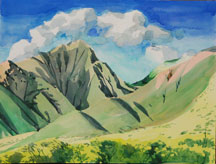
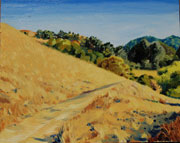
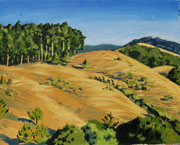
I took advantage of the mild October weather (read: not rainy) to do a couple of quick oils in the park behind our house. Finding a cow-free spot requires a mile-long trek uphill through hot dusty fireroads. I normally take a $30. aluminum portable easel, a hat, a snack, a bottle of water, my sunglasses, a long sleeved shirt, and a foldable chair that doubles as backpack. Inside are no more than six tubes of basic colors, a pad of disposable palette paper, some turpentine, a set of about 20 hog brushes, a bit of stand oil, and some rags. Sometimes I bring a pencil, but most of the time I forget.


It takes me anywhere from one to two hours to complete a 16" by 20" canvas, if it's not too windy. I try to find a shady spot, but if I do, I end up wearing a jacket. All that sitting makes you lose your body heat eventually. As with watercolors, size makes a big difference in your execution. A smaller canvas means you can spend more time on details you'd have to ignore otherwise. The smaller your painting surface, the more thought you can give to what you're painting.


What do I think about? I periodically survey the whole picture from a distance. If I cannot get up to look at it from four to five feet, I half-close my eyes to obliterate seductive but ultimately periferal details. I also keep a running list of what I need to correct. Some corrections I leave for home, and some need to be immediate. At times I stop and just look very carefully. Later, I might use that memory to modify an element in the picture. In short, plein air painting is about constant revision, or revision-on-the-go.